How to Fund AI Education Programs: Title IV, 21st CCLC, ASES, ELO-P, and More
The biggest barrier to launching an AI education program is rarely the technology or the curriculum. It is the budget. Administrators want to say yes, but they need to know how to pay for it.
The good news? There are more funding sources available for AI and STEM enrichment programs than most people realize. The challenge is knowing which ones apply, how to position your program in the application, and what documentation you need to submit.
This guide breaks down the major federal and state funding streams, explains how AI game design programs like Clever Games qualify under each one, and gives you practical language and strategies for strengthening your application.
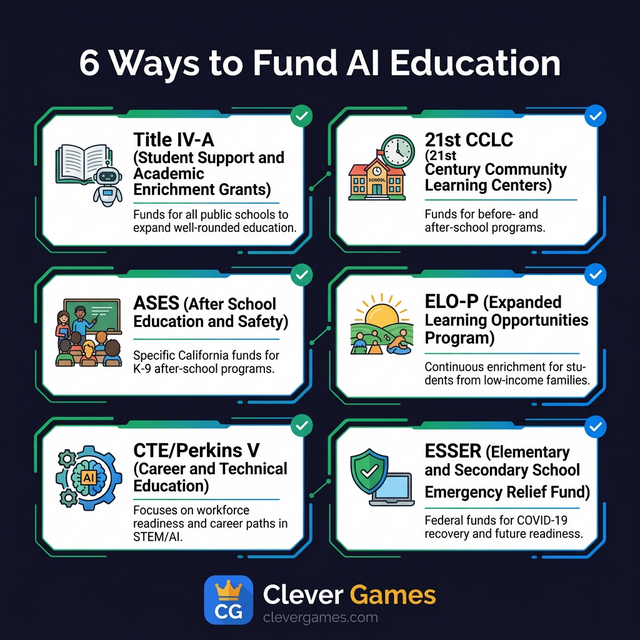
Federal Funding Sources
Title IV-A (Student Support and Academic Enrichment)
What it is: Title IV-A, also known as the Student Support and Academic Enrichment (SSAE) program, provides formula-based funding to every state and, through states, to school districts.
Annual funding: Approximately $1.3 billion nationally
How it works: Districts receive an allocation and can direct funds across three categories:
- Well-rounded education programs (arts, STEM, computer science, career education)
- Safe and healthy students (mental health, drug prevention, physical education)
- Effective use of technology (digital learning, blended instruction, tech tools)
AI game design programs qualify under both "well-rounded education" and "effective use of technology." If your district receives Title IV-A dollars, this is one of the easiest entry points.
How to position your application: Focus on the technology literacy and computer science alignment. Cite CSTA and ISTE standards. Emphasize that students learn prompt engineering, computational thinking, and digital storytelling through hands-on creation rather than passive consumption. Include the phrase "student-centered technology instruction" because it maps directly to the Title IV-A statutory language.
Sample language for your application:
"This program provides students with access to age-appropriate AI tools within a safe, moderated environment, developing skills in prompt engineering, computational thinking, and digital storytelling. The curriculum aligns with CSTA K-12 Computer Science standards and ISTE standards for students."
21st Century Community Learning Centers (21st CCLC)
What it is: The largest federal funding source dedicated exclusively to afterschool and summer programs.
Annual funding: Approximately $1.3 billion nationally
How it works: Competitive grants are awarded through State Education Agencies (SEAs) to schools and community organizations. Grants typically run 3 to 5 years with annual awards ranging from $50,000 to $200,000+.
AI game design programs are a natural fit because they combine:
- Technology enrichment (students use AI tools to create games)
- Academic enhancement (prompt writing develops literacy and critical thinking)
- Student engagement (gamified elements keep attendance high)
- Family engagement (game showcases bring families to the school)
How to position your application: Emphasize the engagement data. Afterschool programs funded by 21st CCLC are evaluated heavily on consistent attendance and active participation. A program where students are building and publishing their own games has a built-in motivation structure that traditional tutoring programs struggle to match.
Key point for reviewers: 21st CCLC grants require programs to demonstrate a connection between afterschool activities and academic improvement. Emphasize that prompt engineering directly develops writing clarity, logical sequencing, and revision skills — competencies measured by standardized assessments.
ESSER / ARP (Elementary and Secondary School Emergency Relief)
What it is: Emergency federal funding enacted during the COVID-19 pandemic to support learning recovery.
Status: While ESSER funds are winding down, many districts still have unspent ESSER III (ARP) allocations that must be obligated by September 30, 2024 and liquidated by January 2025. Check with your district's business office for remaining balances.
How it works: ESSER is extremely flexible. Funds can be used for almost any educational purpose that addresses learning loss or re-engagement.
AI education programs qualify because they:
- Address learning loss through project-based engagement
- Build technology skills that students missed during remote learning disruptions
- Provide measurable outcomes (published games, curriculum completion rates, attendance data)
- Re-engage students who have become chronically absent or disengaged
How to position your application: Frame the program as a engagement-focused learning recovery initiative. Reference research on project-based learning outcomes and student re-engagement strategies. If your district has attendance or chronic absenteeism data, use it to justify a program specifically designed to bring students back.
CTE / Perkins V (Career and Technical Education)
What it is: Federal funding for career and technical education programs that prepare students for high-skill, high-wage, or in-demand occupations.
Annual funding: Approximately $1.4 billion nationally
How it works: States receive formula allocations and distribute to local districts and career-tech centers. Programs must connect to recognized Career Clusters and career pathways.
AI game design sits at the intersection of multiple Perkins-eligible career pathways:
| Career Cluster | Connection |
|---|---|
| Information Technology | AI tools, software platforms, digital systems |
| Arts, A/V Technology & Communications | Game design, visual arts, digital media |
| STEM | Computational thinking, data literacy, problem-solving |
How to position your application: Connect the curriculum to career readiness. Show that students are building portfolio-worthy projects that demonstrate skills employers actually value: AI tool proficiency, visual design, iterative problem-solving, and creative collaboration. Use the phrase "work-based learning simulations" to describe the game publication process, where students go through ideation, production, quality review, and release — mirroring a real product development cycle.
State Funding Sources
ASES (After School Education and Safety) - California
What it is: California state funding for afterschool and before-school programs at elementary and middle schools.
Annual funding per site: $112,500 for 3-hour programs; pro-rated for shorter programs
How it works: Grants are administered through the California Department of Education (CDE). Programs must operate during every regular school day and provide both an academic component and an enrichment component.
AI game design qualifies as the enrichment component because it develops technology literacy, creative thinking, and collaborative skills. It can also serve as an academic component when framed around writing (prompt engineering), mathematics (game logic and scoring systems), and science (computational thinking).
How to position your application: Emphasize the educational enrichment angle. Show that students are learning standards-aligned content (CSTA, Common Core) through an engaging format that keeps them on campus and safe during afterschool hours. ASES reviewers specifically look for programs that address both academic and enrichment needs simultaneously.
ELO-P (Expanded Learning Opportunities Program) - California
What it is: California funding for before school, afterschool, and summer school enrichment programs for TK through 6th grade students.
Annual funding: $4 billion statewide (as of 2023-24)
How it works: Funding flows through Local Control Funding Formula (LCFF) to school districts based on unduplicated pupil counts. Districts must offer 9 hours of combined instruction and expanded learning, and 30 additional summer school days.
ELO-P specifically supports:
- Hands-on learning experiences
- Enrichment activities that complement academics
- Programs that increase student engagement and attendance
- Activities aligned with the school day curriculum
AI game design is a strong fit because it is inherently hands-on (students create and publish games), enriching (develops multiple academic competencies simultaneously), and engaging (gamified elements and tangible outcomes drive participation).
How to position your application: Focus on the hands-on, project-based nature of the program. ELO-P reviewers want to see that students are actively creating, not passively consuming content. A program where every student publishes a real, playable game makes this case compellingly.
Important note: ELO-P funding is allocated based on enrollment, not competitive grant applications. If your district receives LCFF funds and serves eligible students, the funding may already be available. Contact your district's Expanded Learning coordinator.
Other State and Local Sources
Beyond the major programs above, check these additional options:
- State Computer Science Funds: Many states have earmarked funding for K-12 computer science education
- LCAP/LCFF Supplemental Funds: California districts can use supplemental and concentration funds for technology enrichment
- PTA/PTO Grants: Many parent organizations fund supplemental programs
- Corporate Partnerships: Local tech companies often sponsor STEM education programs
- Community Foundation Grants: Regional foundations frequently fund youth technology education
Tips for Strengthening Any Application
Regardless of which funding source you pursue, these strategies improve your chances:
1. Lead with Outcomes, Not Features
Grant reviewers do not care about the technology platform. They care about what happens to students. Frame everything around student outcomes:
- Skills developed (prompt engineering, computational thinking, visual design)
- Projects completed (every student publishes a playable game)
- Engagement levels (attendance rates, daily participation)
- Career readiness (portfolio creation, AI literacy skills)
- Academic connections (writing clarity through prompt engineering, math through game logic)
2. Provide Standards Alignment Documentation
Every serious application needs to show alignment to recognized standards. When evaluating AI education platform vendors, look for providers that supply pre-built alignment documentation for:
- CSTA (Computer Science Teachers Association K-12 standards)
- ISTE (International Society for Technology in Education standards)
- Common Core (ELA and Math connections through prompt writing and game logic)
- Next Generation Science Standards (computational thinking practices)
3. Include Per-Pupil Cost Breakdowns
Make it easy for reviewers to understand the economics. A clear table showing cost per student, cost per site, and what is included removes ambiguity:
| Item | Cost |
|---|---|
| Platform access (per student, per year) | $XX |
| Curriculum materials (included) | $0 |
| Facilitator training (included) | $0 |
| Technical support (included) | $0 |
| Total per student | $XX |
Contact your vendor for exact pricing to fill in this table.
4. Show Your Safety and Compliance Posture
For any program serving minors, COPPA and FERPA compliance is mandatory. Include these details prominently in your application:
- Platform compliance certifications
- Data processing agreement (DPA)
- Content moderation workflow description
- Student privacy protections (username-based identity, instructor-gated publishing)
5. Request a Letter of Support
Many AI education providers will supply a letter of support, partnership documentation, or program descriptions tailored to your specific application. This shows the reviewer that you have a committed partner, not just a software subscription.
6. Include a Sustainability Plan
Grant reviewers love to see how you will sustain the program after the funding period ends. Options include:
- Integration into the school district's ongoing technology budget
- Transition to a different funding stream (e.g., moving from ESSER to Title IV-A)
- Partnership with organizations like Afterschool.org (utilizing a student-staffing model developed by Student Hires) for ongoing staffing
- Revenue from camp fees (for summer programs)
Documentation Checklist for Grant Applications
Before submitting any application, make sure you have:
- Standards alignment documentation (CSTA, ISTE, Common Core)
- COPPA and FERPA compliance certifications
- Data Processing Agreement (DPA)
- Program outcomes and engagement metrics templates
- Sample grant language and program descriptions
- Budget templates with per-pupil cost breakdowns
- Letters of support from vendor and community partners
- Facilitator training plan and materials overview
- Sustainability plan for post-grant continuation
If your vendor cannot provide these, consider whether they are truly ready for institutional deployment.
Clever Games provides all of the above. Visit the Funding and Grants page for ready-to-use documentation, or contact the grants team for custom support.
Timeline: When to Apply
Most grant programs have annual application cycles. Here is a general timeline for planning:
| Funding Source | Typical Application Window | Program Start |
|---|---|---|
| Title IV-A | Districts allocate annually (varies) | School year |
| 21st CCLC | January - March (varies by state) | Fall |
| ASES | Ongoing or biannual | School year |
| ELO-P | District-level allocation | School year |
| CTE / Perkins V | Spring - Summer (varies by state) | Fall |
Start planning 6 to 9 months before you want the program to launch. This gives you time to gather documentation, secure buy-in from administrators, and submit a polished application.
The Window Is Open
Federal and state educational priorities are increasingly aligned with AI literacy, technology education, and creative STEM. The U.S. Department of Labor has published an AI Literacy Framework that signals where policy is heading. Programs that position themselves at this intersection are well-positioned for funding today and for continued support as AI education becomes a standard part of the K-12 experience.
The applications are open. The tools are ready. The question is whether your district will move now or wait.
Explore all Clever Games program options or schedule a discovery call for your district.
The Clever Games team writes about AI in education, game design, and the future of K-12 computer science. We build tools that help students learn by creating.
View all articles →